
Peptide Arrays: Applications in Molecular Biology
Introduction
Peptide arrays represent a powerful experimental platform used to investigate molecular interactions, enzyme activities, and protein–peptide binding mechanisms. By enabling the simultaneous analysis of hundreds or thousands of peptide sequences, peptide arrays provide a high-throughput approach for studying sequence-dependent biological processes.
This technology plays an important role in several fields of modern biotechnology, including:
-
molecular pathway analysis
-
biomarker discovery
-
drug development
-
enzyme characterization
-
disease diagnosis and monitoring
Because peptides are key components of many biological interactions, peptide arrays allow researchers to systematically explore how amino-acid sequence variations influence molecular recognition and biochemical activity.
Major Applications of Peptide Arrays
Peptide arrays have become widely used in biological research due to their versatility and scalability. Some of the most important applications include:
- Epitope mapping for antibody recognition
-
Analysis of protein–peptide binding interactions
-
Identification of enzyme substrates
-
Profiling enzymatic activity in complex biological samples
-
Discovery of peptides involved in cell adhesion
Each of these applications contributes to a deeper understanding of cellular mechanisms and protein regulation.
Epitope Mapping for Antibody Recognition
One of the most common uses of peptide arrays is the identification of antibody-binding epitopes.
Epitope mapping involves synthesizing overlapping peptide fragments derived from a target protein and arranging them on an array surface. When the array is exposed to patient serum or antibody samples, binding patterns reveal which peptide sequences are recognized by antibodies.
This approach is widely used in:
-
Infectious disease research
-
Vaccine development
-
Autoimmune disease studies

-
Diagnostic biomarker discovery
For example, peptide arrays can analyze antibody responses against surface proteins of pathogens. Arrays containing hundreds of short peptides representing different regions of a protein antigen can reveal distinct antibody recognition patterns among patient groups.
These patterns may help distinguish:
-
infected individuals
-
healthy individuals
-
different stages of disease progression
However, a limitation of linear peptide arrays is that they mainly detect linear epitopes, while conformational epitopes formed by protein folding may not be detected.
Identification of Protein–Peptide Binding Interactions
Peptide arrays are also widely used to investigate binding interactions between proteins and peptide ligands.
In this approach, arrays containing systematically designed peptide sequences are incubated with purified proteins. Binding events are then detected using fluorescent or enzymatic labeling methods.
These experiments allow the identification of:
-
consensus binding motifs
-
high-affinity ligand sequences
-
binding preferences of protein domains
Such information is valuable for understanding protein signaling pathways and molecular recognition mechanisms.
However, detecting weak binding interactions can be challenging because peptide–protein complexes must remain stable during washing steps before imaging. Weak interactions with micromolar binding affinities may dissociate during the experimental procedure.
To overcome this limitation, specialized techniques have been developed that convert transient binding events into detectable enzymatic signals, enabling the study of low-affinity interactions in array formats.
Kinetic Analysis of Protein Binding
In addition to identifying binding sequences, peptide arrays can be combined with biophysical detection technologies to analyze interaction kinetics.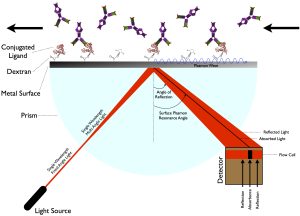
Techniques such as surface plasmon resonance (SPR) imaging allow real-time monitoring of binding events between proteins and immobilized peptides.
This approach provides detailed information about:
-
association rates
-
dissociation rates
-
binding affinity
Kinetic analysis helps determine how proteins recognize specific peptide motifs and contributes to the understanding of protein signaling networks and transcriptional regulation.
Enzyme Substrate Identification
Another major application of peptide arrays is the identification of enzyme substrates and recognition motifs.
Enzymes such as:
-
kinases
-
methyltransferases
-
acetyltransferases
-
proteases
often recognize specific peptide sequences within proteins. By synthesizing peptide libraries that systematically vary amino acid positions, peptide arrays allow the determination of sequence requirements for enzyme activity.
This approach helps identify:
-
minimal recognition motifs
-
preferred amino acid substitutions
-
sequence determinants for enzymatic modification
For example, peptide arrays can reveal which amino acid sequences are preferentially modified by protein methyltransferases or acetyltransferases, providing insights into post-translational modification pathways.
Profiling Enzyme Activity in Complex Samples
Peptide arrays can also be used to measure enzyme activities directly in complex biological samples, including:
-
cell lysates
-
tissue extracts
To perform these analyses, peptide substrates are immobilized on array surfaces and exposed to biological samples containing active enzymes.
The resulting enzymatic modifications are then detected using:
-
fluorescence assays
-
radiolabeled substrates
-
mass spectrometry
Mass spectrometry based approaches, such as self-assembled monolayer desorption ionization (SAMDI), enable label-free and quantitative measurement of enzymatic activity.
These methods provide several advantages:
-
high sensitivity
-
minimal background interference
-
high throughput analysis
Using peptide arrays, enzyme activities such as deacetylation, phosphorylation, or methylation can be profiled simultaneously across many substrates.
Studying Enzyme Regulation and Substrate Specificity
Peptide arrays are particularly valuable for exploring how post-translational modifications influence enzyme activity.
Certain modifications on a peptide substrate may enhance or inhibit additional modifications, a phenomenon known as post-translational modification crosstalk.
For example, modification of one amino acid residue may alter the accessibility or recognition of another nearby residue by regulatory enzymes.
These experiments help reveal complex regulatory networks controlling chromatin structure, transcription, and signal transduction.
Peptide arrays can also be used to compare wild-type enzymes with mutant variants, allowing researchers to determine how structural changes influence enzyme specificity.
High-Throughput Screening for Enzyme Inhibitors
Peptide arrays can serve as effective platforms for screening large libraries of chemical compounds.
When a peptide substrate is immobilized on the array surface, enzymatic activity can be monitored in the presence of thousands of potential inhibitor molecules. This approach enables rapid identification of drug candidates that block enzyme activity.
High-throughput screening strategies using peptide arrays are particularly valuable in drug discovery programs targeting epigenetic enzymes, proteases, or signaling proteins.
Cell Adhesion Studies
Peptide arrays are also used to identify peptide sequences that mediate cell adhesion.
Cell adhesion plays a fundamental role in biological processes such as:
-
tissue formation
-
immune responses
-
cancer metastasis
By screening peptide libraries derived from extracellular matrix proteins, peptide arrays can identify short peptide motifs that promote cell attachment.
Cells are incubated on the peptide array surface, and binding events are detected using fluorescent dyes or microscopy techniques.
These experiments help discover adhesion ligands that interact with cell surface receptors, providing valuable tools for tissue engineering and biomaterials design.
However, results must be interpreted carefully because nonspecific protein adsorption or cell attachment may occasionally produce misleading signals.
Peptide Arrays for Cellular Activity Profiling
Recent developments have expanded peptide array applications to include cell-based enzyme activity assays.
In these systems, peptide substrates and cell adhesion ligands are presented on the same surface. Cells can grow directly on the array surface, and when they are lysed, intracellular enzymes immediately interact with nearby peptide substrates.
This design allows direct measurement of cellular enzyme activity with minimal delay, improving detection sensitivity.
Advanced versions of this method can measure enzymatic activity from very small numbers of cells, making the approach useful for studying rare cell populations.
Emerging Applications of Peptide Arrays
Peptide arrays continue to expand into new areas of biotechnology and materials science. Emerging applications include:
-
site-specific peptide modification reactions
-
systems-level analysis of enzyme activity networks
-
discovery of peptides that interact with nanomaterials
-
development of peptide-based biosensors
Another important development is the integration of machine learning and computational modeling to analyze the extremely large datasets generated by high-density peptide arrays.
These approaches improve:
-
peptide library design
-
prediction of binding interactions
-
identification of optimal peptide sequences for therapeutic applications
Conclusion
Peptide arrays have become an essential technology for modern molecular biology and biomedical research.
Their ability to simultaneously analyze thousands of peptide sequences enables detailed investigation of:
-
antibody recognition
-
protein–peptide interactions
-
enzyme specificity
-
cellular signaling mechanisms
-
peptide-mediated cell adhesion
Advances in analytical techniques, mass spectrometry, and computational analysis continue to enhance the capabilities of peptide arrays. As array density and throughput increase, peptide arrays will play an even more important role in drug discovery, diagnostics, and systems biology.